Quick Answer
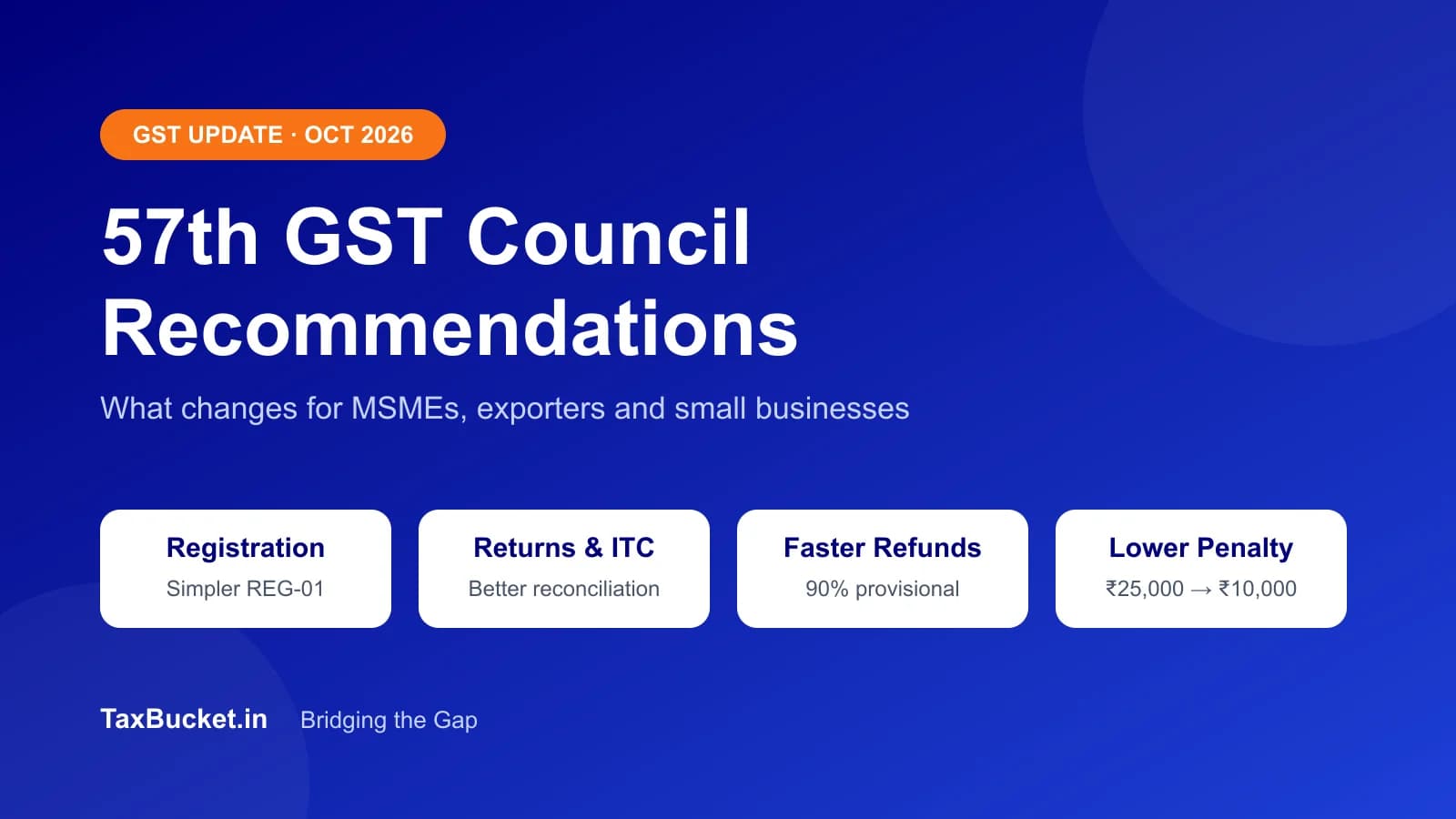
The 57th GST Council meeting, held on 8 October 2026, recommended simpler GST registration, better reconciliation of GSTR-1, GSTR-3B and input tax credit, faster system-based refunds, a lower maximum general penalty (from ₹25,000 to ₹10,000), late fee relief for small taxpayers and an optional ARQP scheme for small B2C businesses. These are recommendations: each one applies only after the relevant notification, circular or amendment and its effective date.
Key highlights of the latest GST updates
India's Goods and Services Tax (GST) framework is set for further changes following the 57th GST Council meeting held on 8 October 2026. The recommendations are particularly relevant for MSMEs, startups, manufacturers, exporters, traders, service providers and e-commerce sellers. In this article, TaxBucket, a Delhi-based GST consultant, explains each recommendation and what it means for your business. For the CBIC circulars issued later in the month, see Latest GST Circulars: October 2026.
The major recommendations include:
- Simplification of GST registration and amendment procedures
- Improved reconciliation of GSTR-1, GSTR-3B and input tax credit
- Faster, system-based processing of eligible GST refunds
- Proposed reduction in the maximum general penalty from ₹25,000 to ₹10,000
- A proposed minimum threshold of ₹10,000 for issuing GST show-cause notices
- Proposed expansion of ITC refund eligibility in specified cases
- Simplified GST registration for certain small e-commerce sellers
- Proposed relief in late fees for eligible small taxpayers
- Changes proposed to GST arrest and prosecution provisions
- An optional Annual Return Quarterly Payment (ARQP) scheme approved in principle for eligible small businesses
These are recommendations announced by the GST Council. Their implementation depends on the applicable notifications, circulars, statutory amendments and effective dates. Verify the legal position before relying on any proposed change.
GST registration process may become simpler
The GST Council has recommended measures to make GST registration more transparent and easier to complete:
- Clearer guidelines on the documents required for GST registration
- Improvements to Form GST REG-01
- A more user-friendly GST portal interface
- Better guidance for applicants during registration
- Automatic acceptance of certain amendments to registration particulars, subject to the prescribed conditions
These changes are intended to reduce avoidable registration queries, document-related errors and unnecessary delays.
Businesses applying for GST registration should ensure that their PAN, address proof, business constitution documents, bank details and other supporting information are accurate and consistent. Existing taxpayers should review their registration details whenever there is a change in business address, contact information, authorised signatory or other particulars. The proposed automatic amendment facility will operate according to the applicable rules and exceptions.
TaxBucket Tip: Do not assume that every GST registration application or amendment will be approved automatically. Check the eligibility conditions and portal requirements before applying.
Major changes proposed for GST returns and ITC reconciliation
Differences between GSTR-1, GSTR-3B, GSTR-2B and purchase records can lead to reconciliation problems, ITC disputes and departmental notices. The Council has recommended improvements to the return filing system, including:
- Better reconciliation between outward supply details and GSTR-3B
- Improved reporting of reverse charge mechanism (RCM) liabilities
- An electronic statement for tax paid under RCM and ITC claimed
- Better reporting of ITC reversals and subsequent reclaims
- Improved mechanisms to align ITC claimed in GSTR-3B with ITC available in GSTR-2B
- Improvements to the Invoice Management System (IMS)
The Council recommended that the proposed alternative mechanism for correcting tax liability and ITC in GST returns may be implemented from the return period of April 2027, subject to the prescribed implementation process.
Until then, continue following the current return requirements. A practical monthly GST compliance checklist:
- 1
Sales vs GSTR-1
Reconcile sales as per books with GSTR-1.
- 2
GSTR-1 vs GSTR-3B
Reconcile tax liability reported in GSTR-1 with GSTR-3B.
- 3
Purchases vs GSTR-2B
Compare purchase registers with GSTR-2B.
- 4
ITC eligibility
Verify ITC eligibility before claiming credit.
- 5
Notes and amendments
Review credit notes, debit notes and amendments.
- 6
RCM
Identify and correctly report RCM liabilities.
- 7
Records
Maintain supporting invoices and payment records.
- 8
Reversals
Review ITC reversals and reclaims before filing returns.
Faster GST refunds for exporters and businesses
The GST Council has recommended measures to automate and accelerate the processing of eligible refund applications. The proposed first-phase measures include:
- Automatic sanction of eligible refunds of excess balances in the electronic cash ledger
- Reduction of the acknowledgement or deficiency memo period from 15 days to 10 days
- Deemed acknowledgement where the prescribed response is not issued within 10 days
- Provisional sanction of 90% of eligible refund claims relating to zero-rated supplies and inverted duty structure, based on the prescribed risk assessment
Further automation is proposed in a subsequent phase, along with changes to the refund application process and certain refund calculation rules.
These measures could be particularly relevant to exporters of goods and services, suppliers to eligible SEZ recipients, manufacturers facing an inverted duty structure, businesses with eligible excess cash ledger balances and taxpayers facing working capital pressure because of pending refunds. Keep complete supporting documents, reconcile your returns and check the eligibility conditions for your refund category.
The proposed 90% provisional refund is not a blanket entitlement for every taxpayer. Eligibility, risk assessment and implementation requirements must be checked under the applicable provisions.
Proposed reduction in the maximum general GST penalty
The Council has recommended reducing the maximum general penalty under Section 125 of the CGST Act, 2017 from ₹25,000 to ₹10,000.
It has also recommended a reduced penalty of 5% in certain non-fraud cases where tax and interest are paid within the specified period after an adjudication order, a minimum threshold of ₹10,000 for issuing show-cause notices, and removal of the minimum penalty of ₹10,000 in specified non-fraud cases. These proposals have different conditions and are not a universal reduction in every GST penalty.
The recommendations are not permission to delay returns, under-report sales or claim ineligible ITC. Businesses should continue to:
- File GST returns within the applicable deadlines
- Pay tax liabilities on time
- Reconcile turnover and tax payments
- Respond to GST notices within the prescribed period
- Maintain supporting documents and accounting records
Where a notice has already been received, review the applicable provisions and effective dates before deciding how to respond.
GST arrest and prosecution provisions: proposed changes
- Proposed removal of arrest powers under Section 69 of the CGST Act
- A proposed increase in the monetary threshold for prosecution from ₹1 crore to ₹5 crore
- Proposed rationalisation of certain offences and punishments under Section 132
These recommendations are part of a broader effort to simplify compliance and make tax administration more predictable, while retaining measures to deter fraud and tax evasion.
These are proposed legislative changes. Do not assume that existing enforcement provisions have stopped applying merely because the Council has recommended amendments.
Relief for small taxpayers: proposed late fee waiver
The Council has recommended a waiver of late fees for delayed returns under Section 39(1) of the CGST Act for taxpayers whose aggregate turnover in the preceding financial year does not exceed ₹5 crore, subject to the prescribed conditions. One stated condition is that the delayed return must be filed by the end of the month in which it was due.
Small businesses should not deliberately delay filing in anticipation of a waiver. Instead:
- Identify any pending GST returns (our free GST Health Check shows your recent filing history)
- Calculate outstanding tax liabilities and applicable interest
- Verify the latest applicable late fee provisions
- Check whether any notified waiver applies to you
- File outstanding returns within the applicable deadline
Input tax credit refunds: proposed expansion of eligibility
The Council has recommended amendments to expand refund eligibility for accumulated ITC in certain cases:
| Category | Proposed change | Proposed applicability |
|---|---|---|
| ITC on input services under inverted duty structure | Refund eligibility to be expanded | ITC availed on or after 1 November 2026 |
| ITC on capital goods for zero-rated supplies and inverted duty structure | Refund eligibility to be expanded, with refunds spread over 60 months | ITC availed on or after 1 April 2027 |
Accumulated ITC can block working capital. The proposed changes could improve cash flow for eligible exporters and businesses under an inverted duty structure. Keep detailed records of input services, capital goods, invoices and ITC utilisation so you can evaluate eligibility when the provisions take effect.
Simplified GST registration for small e-commerce sellers
The Council has recommended a simplified registration mechanism for certain small suppliers selling goods through e-commerce operators. Eligible sellers may be able to use an e-commerce operator's warehouse in a State or Union Territory as their principal place of business, subject to the prescribed conditions.
This could help small manufacturers, online retailers, local product brands and home-grown businesses expand to other States without setting up their own premises in each one. Businesses planning interstate e-commerce sales should review their registration requirements before starting operations in additional States.
Optional Annual Return Quarterly Payment (ARQP) scheme
The Council has approved in principle a concept note for an optional ARQP scheme. It is intended for eligible taxpayers with aggregate turnover of up to ₹5 crore in the preceding financial year who make supplies only to unregistered persons (B2C supplies).
Approval in principle does not mean the option is available immediately. The detailed framework, eligibility, payment procedure and implementation date should be checked once formally notified. Eligible businesses should continue their current filing and payment practice until then.
Other GST recommendations businesses should monitor
- ITC on specified business expenses: Changes to blocked ITC provisions for certain outdoor catering, health and life insurance, telecommunication towers, pipelines outside factory premises, free samples and goods destroyed or written off on expiry of shelf life as required by law.
- Waste and scrap transactions: Changes for certain plastic, electrical and electronic waste, tyre scrap and used cooking oil, including proposed RCM for specified transactions and TDS for certain registered-to-registered supplies.
- Export of services: Proposed IGST Act changes to facilitate export benefits for certain service providers, including specified situations involving foreign offices or branches.
- E-invoicing: Proposed extension to specified domestic supplies received from unregistered persons under RCM, and imports of services, for taxpayers with aggregate annual turnover of ₹5 crore or more.
Exact eligibility and obligations will depend on the final notifications and implementation dates.
Official reference: 57th GST Council meeting recommendations (PIB)
GST compliance checklist for November 2026
- Reconcile sales recorded in accounting software with GSTR-1
- Reconcile GSTR-1 with GSTR-3B
- Match purchase records with GSTR-2B
- Verify ITC eligibility and record necessary reversals
- Review RCM liabilities and applicable payments
- Check outstanding GST returns and notices
- Verify GST registration details and bank information
- Maintain invoices, credit notes, debit notes and supporting records
- Review e-invoicing and e-way bill applicability
- Monitor official notifications implementing the October 2026 recommendations
- Review refund eligibility and pending refund applications
- Confirm the correct GST rates using the latest applicable notifications
GST Council recommendations are not a substitute for the law in force. Continue filing returns, paying taxes and claiming ITC according to the current provisions.
How TaxBucket can help with GST compliance
GST compliance involves more than filing monthly or quarterly returns. TaxBucket provides taxation, accounting, compliance and business advisory services to businesses in Delhi and across India, including:
- GST registration and amendments
- Monthly and quarterly GST return filing
- GSTR-1, GSTR-3B and GSTR-2B reconciliation, and GSTR-9 annual return
- Input tax credit review
- GST refund and notice assistance
- E-invoicing and e-way bill compliance support
- GST compliance reviews for businesses
As the recommendations are implemented, review the changes relevant to your industry and update your compliance process. Whether you are a startup, trader, manufacturer or service provider, our team can help you manage GST efficiently.
Looking for the best tax consultant in Delhi? TaxBucket is a Delhi-based team of CAs, CSs, CMAs and tax experts with its office on Palam Dabri Road, South West Delhi, rated 5.0 on Google by 119 clients. We help businesses and individuals across Delhi NCR and all over India. Talk to a tax consultant in Delhi or contact us.
Frequently asked questions
What are the latest GST updates in India as of October 2026?
The major updates are the recommendations of the 57th GST Council meeting held on 8 October 2026. They cover registration, return reconciliation, refunds, penalties, prosecution, ITC refunds and simplified compliance for eligible small taxpayers.
Has the maximum general GST penalty been reduced to ₹10,000?
The Council has recommended reducing the maximum general penalty under Section 125 of the CGST Act from ₹25,000 to ₹10,000. Verify the statutory amendment and its effective date before relying on the change.
Is the proposed late fee waiver available to all small businesses?
No. It covers eligible taxpayers with turnover up to ₹5 crore in the preceding financial year, subject to prescribed conditions. Check the notification and effective date.
Will GST refunds become faster?
The Council has recommended system-based refund processing, including automatic sanction of eligible excess cash ledger balances and provisional refunds for specified zero-rated and inverted duty structure claims. Implementation and eligibility depend on the final provisions.
What should businesses do about ITC reconciliation?
Regularly reconcile purchase records with GSTR-2B, verify ITC eligibility, check reversals and reclaims, and report accurately in GSTR-3B.
Are the October 2026 GST recommendations already applicable?
Not necessarily. Some measures need amendments, notifications or circulars before they take effect. Check official GST Council and CBIC publications for the current legal position.